
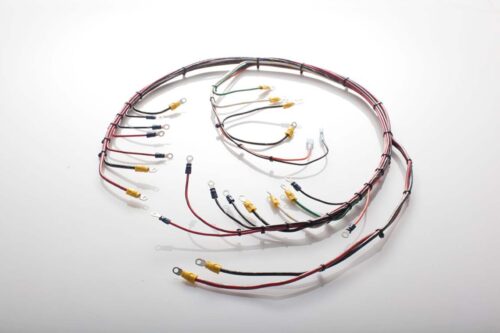
Ensuring the safety and performance of medical devices starts long before a product reaches a clinical setting. For Original Equipment Manufacturers (OEMs), the reliability of internal components such as wire harnesses is a critical factor in achieving full compliance with industry safety standards.
Electri-Cord Manufacturing Co. (ECM) is a leading manufacturer of high-precision medical device wiring harnesses, overmolded cable assemblies, power cords, and custom interconnect solutions. Since 1946, ECM has built a reputation as a turnkey partner for Tier 1 Medical Device and Laboratory Equipment OEM’s, providing the technical expertise, process controls, and manufacturing capabilities required for complex medical electronics.
Learn more about medical regulatory standards, essential OEM requirements, and specialized testing protocols.
Key Standards and Certifications for Medical Wire Harnesses
Understanding medical device wire harness requirements is essential for OEMs navigating this complex environment. As a medical cable assembly manufacturer, we maintain a robust quality management system to ensure every component meets global safety benchmarks.
- Supporting ISO 13485-Compliant OEM Programs. ISO 13485 is the globally recognized quality management framework for medical device manufacturers. Our manufacturing processes, documentation practices, traceability controls, and quality procedures are designed to support OEM customers operating within ISO 13485-regulated environments.
- UL & CSA Recognition. Our medical-grade products carry UL certification to meet electrical safety standards like UL 60601-1, which verifies that harnesses withstand tests for flammability, insulation, and current leakage.
- IPC/WHMA-A-620 Standards. We align assembly instructions and operator training with IPC/WHMA-A-620 requirements to ensure consistently high-quality output in crimping, soldering, and terminations.
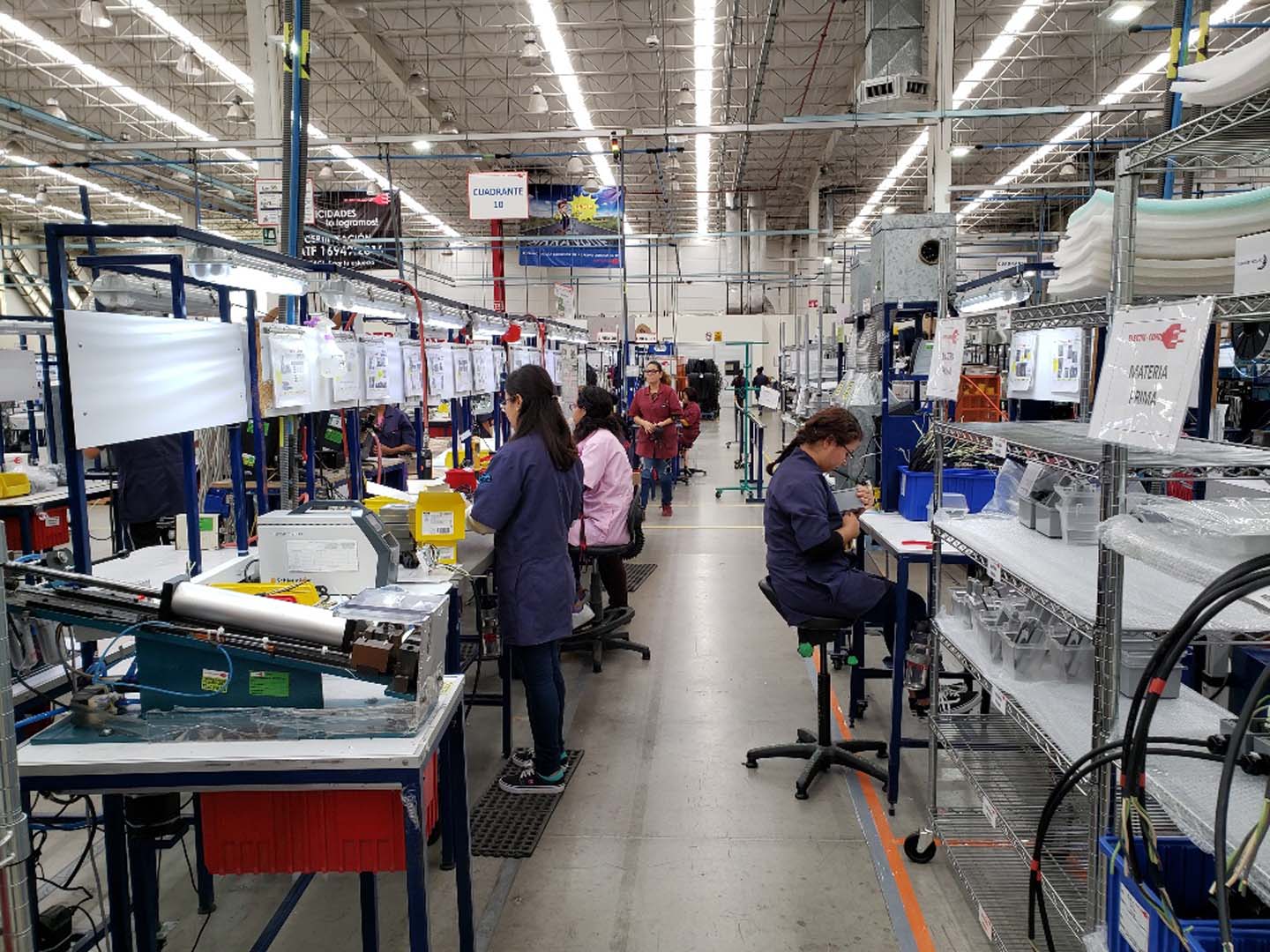
What OEMs Should Require from a Wire Harness Manufacturer
Selecting a medical cable assembly manufacturer involves more than a review of basic production skills. High-performance partnerships require specific verification of capabilities and certifications to ensure delivery of hospital-grade components.
When you evaluate potential partners, prioritize these criteria:
- Quality Management Alignment. Confirm the manufacturing partner maintains documented quality systems, traceability procedures, and controlled manufacturing environments that support medical OEM compliance requirements.
- Workmanship Standards. Request evidence of IPC/WHMA-A-620 compliance. This specification defines the criteria for crimps, soldering, and strain relief.
- Design for Manufacturability (DFM). A qualified manufacturer identifies production issues early in the development cycle. This service reduces the risk of design revisions after you invest in tooling.
- Advanced Manufacturing Capabilities. Manufacturers with in-house overmolding capabilities can improve cable protection, strain relief, and assembly consistency while reducing variability across production runs.
- In-house Testing. Access to hi-pot testing, continuity verification, and pull-force testing accelerates validation.
- Supply Chain Stability. Medical OEMs should evaluate a supplier’s long-term sourcing strategy, component obsolescence management, and multi-region manufacturing capabilities to reduce supply chain risk.
- Material Expertise. Knowledge of medical-grade insulation and shielding ensures appropriate component selection.
Medical device OEMs often require manufacturing partners that can support:
- Low-defect production environments
- Long product lifecycle management
- Detailed traceability documentation
- Engineering collaboration during development
- Controlled change management
- Global manufacturing continuity
Partnering with an experienced wire harness manufacturer helps reduce production risk while supporting regulatory and quality objectives throughout the product lifecycle.
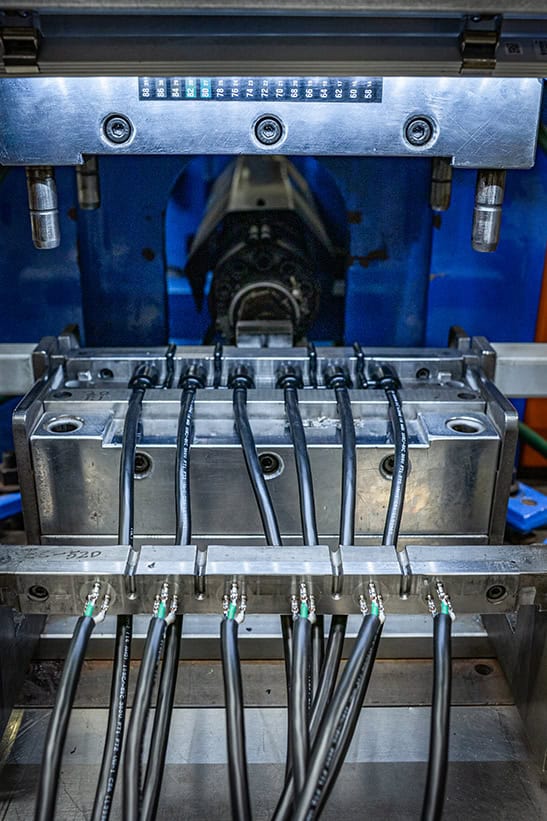
Overmolding for Reliability and Repeatability in Medical Devices
Medical device OEMs often require cable assemblies and wire harnesses capable of withstanding repeated movement, cleaning cycles, and demanding clinical environments. Overmolding provides an additional layer of mechanical protection and process consistency that supports long-term device reliability.
Properly engineered overmolded assemblies can help:
- Improve strain relief and reduce cable fatigue
- Protect connection points from moisture, chemicals, and repeated handling
- Increase assembly repeatability across production volumes
- Reduce the risk of wiring damage during device operation
- Support simplified final assembly for OEM manufacturing teams
- Improve overall product durability in high-use environments
For medical OEMs, repeatability is especially important because consistent cable routing, connector retention, and environmental protection all contribute to device quality and long-term field performance.
ECM works with customers to develop custom overmolded cable assemblies and wire harness solutions tailored to the mechanical, environmental, and usability requirements of medical and laboratory equipment applications.
Material and Biocompatibility Requirements
Meeting medical device wire harness requirements begins with proper material selection. Medical wire harnesses must withstand repeated cleaning and sterilization cycles. They must also resist exposure to body fluids without degrading. Insulation materials must withstand common disinfectants and maintain dielectric properties throughout the device’s lifespan.
Common medical-grade insulation options include:
- PVC Formulations. Specialized medical PVC provides cost-effective performance for applications that do not require aggressive sterilization.
- TPE (Thermoplastic Elastomer). TPE delivers durability for cables subject to frequent movement.
- PTFE (Polytetrafluoroethylene). This material offers chemical resistance and flexibility across a wide temperature range.
Harnesses used in patient-adjacent equipment must often meet ISO 10993 biocompatibility standards. These tests evaluate cytotoxicity, sensitization, and irritation to confirm materials are non-toxic to human tissue. We utilize materials such as medical-grade silicone, which withstands repeated autoclave cycles, and TPU, which performs well through numerous chemical wipe cycles. Manufacturers should always maintain certificates of compliance and test reports to build all teams’ confidence in material safety.
OEMs should work with manufacturing partners capable of maintaining material documentation, supplier certifications, and change-control processes that support regulatory submissions and long-term product lifecycle management.
Testing, Traceability, and Documentation Expectations
To meet medical device wire harness requirements, we perform individual testing on critical components and 100% testing on finished products. These rigorous protocols verify that the harness survives the physical demands of a hospital environment. Working with an experienced medical cable assembly manufacturer ensures these validation steps are performed correctly.
- Continuity and High-Potential (Hi-Pot) Testing. These checks verify electrical integrity and detect potential insulation failures.
- Mechanical Validation. This process includes pull-force testing and flex-cycle validation.
- Full Traceability. We provide lot-based documentation and certificates of origin for every shipment. This level of transparency supports OEMs during regulatory audits or field actions.
For many medical OEMs, supplier traceability and process consistency are as critical as component performance itself. ECM’s controlled manufacturing and documentation practices help support customer audit readiness and risk management initiatives.
We understand that a minor component failure in a medical device can have major consequences. We focus on building trust-based relationships by delivering build-to-spec solutions that exceed industry expectations.
When you need high-quality hospital-grade power cords, wiring harnesses, and medical cable assemblies manufactured to your project’s exact specifications, we have the manufacturing experience, quality-focused processes, and technical capabilities to support your medical device program.
Contact us to discuss your specific medical device wire harness requirements.